
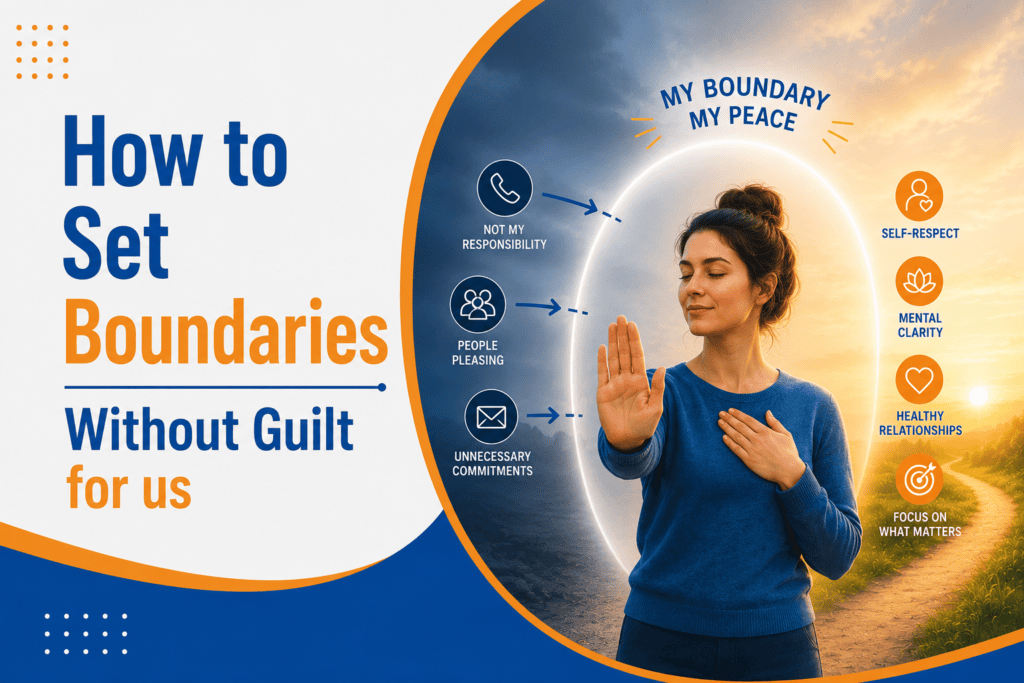
Why Do So Many People Feel Guilty About Setting Boundaries?
One question I hear repeatedly in coaching sessions is, how do I stop feeling guilty when I say NO for something?
What interests me is that the people who ask this question are not selfish. In fact, they are mostly the most caring people in the room. Everyone calls them when they need help, advice, support or a listening ear.
However, constantly being available for everybody can make you less respected. Many people reach a point where they feel emotionally drained, yet they continue saying yes because they have fear of disappointing others. They worry that setting boundaries will make them looks like mean.
The truth is that guilt often appears when we start doing something unfamiliar. If you have spent most of the time putting other people’s needs before your own, then prioritizing yourself again may initially feel uncomfortable.
The Hidden Cost of Always Being Available
I once spoke with someone who told that she is constantly busy. She was helping colleagues at work, supporting family members, responding to messages most of the time and taking responsibility for problems that weren’t hers to solve.
When I asked her how she was feeling, she paused for a moment and said, honestly I feel exhausted all the time.
That answer wasn’t surprising.
Many people believe burnout comes only from working too hard. But no, burnout can also come from constantly carrying emotional responsibilities that do not belong to us. Over weeks, months and years, those small energy leaks have become significant.
Sometimes the issue is not that we have too much to do. The issue is that we have said yes to too many things that do not align with our capacity, priorities or well-being.
Understanding What Healthy Boundaries Really Mean
One of the biggest misconceptions about boundaries is that they create distance between people. In reality, healthy boundaries often improve relationships.
Think about any strong and respectful relationship in your life. Chances are there is clarity, honesty and mutual understanding. Healthy boundaries help create exactly that.
Boundaries are not walls designed to keep people out. They are guidelines that help others understand what works for you and what doesn’t. They communicate your limits in a respectful way.
When people hear the word boundary, they sometimes imagine confrontation. However, most healthy boundaries are actually very simple. They can look like protecting your personal time, declining commitments you can’t manage, limiting draining conversations or choosing not to take responsibility for someone else’s emotions.
Setting a boundary is not an act of rejection. It is an act of self-respect.
Stop Thinking You Need to Explain Everything
One pattern I frequently notice is that people feel forced to justify every boundary they set.
They create long explanations. They search for the perfect reason that will make everyone understand and approve.
The reality is that healthy boundaries do not require a courtroom defense.
The more we over-explain, the more we seek permission. Yet healthy boundaries are not about taking approval for yourself. They are about making decisions that support our well being while remaining respectful to others.
Accept That Not Everyone Will Understand
This can be one of the hardest lessons to learn. When you begin setting boundaries, some people may appreciate them. Others may not.
People who are trying to have unlimited access to your time, energy and attention may struggle with the change. That reaction is natural. However, it does not mean your boundary is wrong.
I often remind people that their responsibility is to communicate with honesty and respect. What others choose to do with that information is beyond their control.
Healthy relationships adapt. They evolve. They create space for both people to have needs and limitations.
If a relationship only works when one person constantly sacrifices him/her, it may be worth reflecting on whether that relationship is truly balanced or not.
Choosing Self-Respect Over Guilt
Over the years, I have noticed that people who experience greater peace are not necessarily those with few responsibilities. They are the ones who understand their limits and respect them.
They know when to start and when to pause. They know when to help and when to not.
Most importantly, they understand that caring ourself is not selfish – it is a need.
Setting boundaries without feeling guilty is a process. It doesn’t happen overnight. There may be moments when you question yourself. There may be times when saying no makes us feel uncomfortable.
But with practice, something powerful begins to happen. You start trusting yourself. You stop measuring your worth by how much you sacrifice. You realize that caring for yourself and caring for others can exist at the same time.
And moreover, that is the most important lesson to all – healthy boundaries do not diminish your kindness. They protect it.
FAQs:-
Guilt comes from habits, beliefs or upbringing that taught us to prioritize others before ourself.
No. Boundaries are the healthiest form of self-respect and emotional responsibility.
Oh! It’s easy. Share your thoughts with heart to heart conversation.
Feeling emotionally exhausted or constantly taken for granted are common signs.
Remain calm, reset your boundary clearly and avoid lengthy arguments for justifications.
Yes, boundaries gives reality check, honest communication and healthy interactions.
Start by conserving your time and energy. Pause before accepting anything and check whether you truly have the capacity for them.