
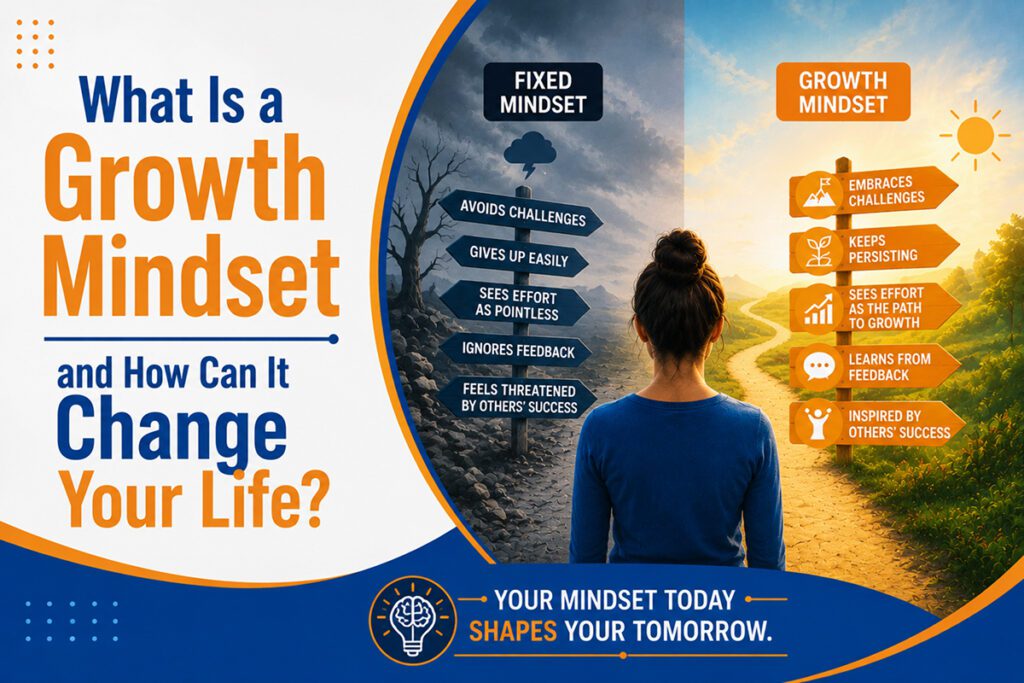
Have you ever caught yourself saying, “I’m just not good at this” or “Nothing can change now”? That small voice in your head might be shaping more of your life than you realize. The way in which you think about your potential, can limit you or unlock your potential to the fullest.
A growth mindset is not always exciting and motivational. It is a strategic way of thinking which makes us a person with growing mindset.
What Actually Is a Growth Mindset?
A growth mindset is the belief that your abilities, intelligence and skills are not limited. They can be brushed up and levelled up with effort, learning and persistence.
It doesn’t mean everyone starts at the same level or success comes easily. Instead, it means you believe improvement is always possible. You should not stuck with what you already know – you can learn more and grow more.
People with a growth mindset see hurdles as opportunities to learn. They understand that struggle is part of growth.
Fixed Mindset vs Growth Mindset
To really understand it, compare it with a fixed mindset.
A person with a fixed mindset believes:
- “Am i good at it or not.”
- “What If I fail?”
- “Effort means I’m not talented.”
A person with a growth mindset believes:
- “I can improve with learning and practice.”
- “Failure is feedback, not my identity.”
- “Efforts are how mastery is built.”
The difference is subtle in words but massive in life outcomes. One keeps you safe but stuck. The other pushes you forward, even when it feels mentally heavy.
How a Growth Mindset Can Change Your Life
Once you start changing your mindset, you begin to notice changes in how you respond to everyday situations.
At workplaces or in institutes, challenges stop feeling like burdens. Instead of avoiding complications, you look into them more consciously because you know they build skill. Feedback doesn’t feel personal – it feels useful.
In relationships, you become more open to communication and less defensive. You understand that people, like skills, also grow and evolve.
Even yourself – talk changes. Instead of “I failed,” you start thinking, “I didn’t get it right yet.” That one word – yet – keeps the possibility alive.
Over time, this mindset builds resilience. You stop quitting early, not because things get easier, but because your reaction to difficulty changes.
Practical Arts to Build a Growth Mindset
This is where most people get stuck – they understand the idea but don’t know how to execute it. The truth is, building a growth mindset is not a one – time decision.
Start by paying attention to your inner self. When you hear yourself saying something limiting, pause and reframe it. Replace “I can’t do this” with “I can learn how to do this.”
Next, get comfortable with discomfort. Growth rarely feels good in the moment. If something challenges you, it’s often a sign you’re actually learning.
Another powerful habit is focusing on effort over outcome. Instead of only celebrating outcomes, start noticing the process – how much time you invest in, what you improved and what it taught along the way.
Also, learn to treat mistakes as data. Every mistake carries information. Instead of hiding from it, ask, “What is this teaching me?”
Surround yourself with people who value growth too. The environment you stay in can either reinforce old thinking or push you forward.
Finally, take small consistent steps. You don’t need a dramatic transformation. Even 10 minutes of consistent practice daily can make you more align towards the growth.
Common Obstacles Everyone Face: –
Shifting to a growth mindset sounds very ok simple, but it’s not always easy in real life.
One major obstacle is the ego. Nobody likes feeling incompetent and growth often requires that uncomfortable stage where you’re bad before you get better.
Another challenge is impatience. We want quick results, but growth is slow and often invisible at first. That’s where most people give up too early.
You may also face environments that reinforce a fixed mindset – people who label you, compare you or discourage effort. In those moments, it becomes even more important to protect your mindset and stay consistent.
Conclusion
A growth mindset doesn’t magically remove problems from your life. It changes how you face them. Instead of seeing limits, you start seeing learning opportunities. Instead of quitting, you start adjusting.
The real shift is this: you stop asking, “Am I good enough?” and start asking, “How can I get better?”
That one shift can quietly reshape your career, your confidence and even your identity over time.
FAQs:-
Yes. It’s not a personality trait – you can build it with awareness, practice and consistent self – reflection over time.
There is no fixed time period. Little changes can start in few weeks, but deeper transformation usually takes months of consistent effort.
No. It actually means acknowledging failure, learning from it and using it as feedback instead of seeing it as a failure.
Yes. It helps you learn faster and feedback better and persist through challenges – all of which are critical for long – term success.
Start noticing yourself – talk. Every time you catch a limiting belief, replace it with a learning – focused thought like “I can improve with practice.”