
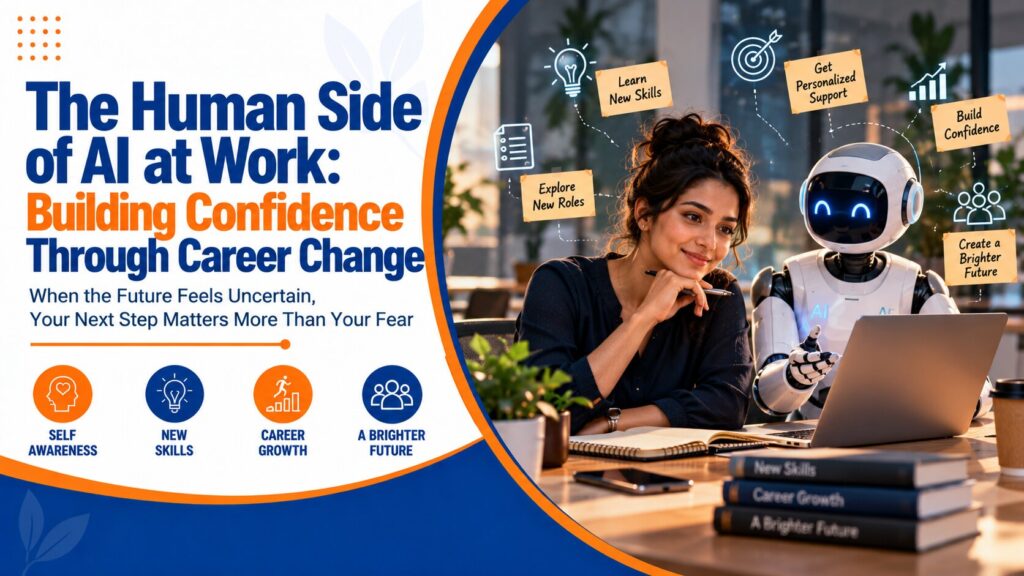
When the Future Feels Uncertain, Your Next Step Matters More Than Your Fear
A story many professionals will recognize
On a Tuesday morning, Priya, a marketing professional, watched an AI tool complete in minutes a task that once took her half a day. Her first thought wasn’t excitement. It was fear: “If AI can do this, will my experience still matter? Could I lose my job?”
For days, Priya imagined the worst. Then she asked her manager how the team’s work might change. The answer wasn’t a guarantee that nothing would change. Routine tasks could become faster, but the team would still need people who could question results, understand customers, make decisions, and communicate clearly.
That conversation didn’t solve everything. It gave Priya something more useful than speculation: a starting point. She began testing AI tools on appropriate tasks, checking their output, and spending more time on creative thinking and strategy. She didn’t need to know everything. She needed to take the next step.
Priya’s story is illustrative, but her questions are real: What happens when work changes? How can we manage career change without losing confidence? And how do we prepare for an uncertain future without letting fear make every decision?
Why change can feel personal?
Work is more than a list of tasks. It can give identity, financial security, relationships and a purpose. So when technology changes a role, it may feel as though our value is being questioned.
It helps to separate a feeling from a fact. Feeling replaceable does not mean you are replaceable. Not knowing exactly what your role will look like next year does not mean you have no future in your field.
In October 2026, WTW’s findings showed that 91% of surveyed employees in India expect AI to fundamentally change their work, with 46% expressing concerns about threats to job security. These concerns deserve empathy, not dismissal. No one can promise that every role will remain the same. But a changing task, a changing job, and a person’s worth are not the same thing.
The aim is not to pretend change is easy. It is to understand what is changing and identify what you can do next.
Fear 1: “Will AI take my job?”
Some tasks may be automated, and some roles may change significantly. But it is not useful to assume that every task a tool can perform makes an entire role unnecessary. Jobs involve different activities: interpreting information, understanding people, making judgements, solving unexpected problems, and taking responsibility.
Write down the main tasks you perform each week. Which are repetitive? Which require experience, creativity, empathy, or decision-making? Which could become more valuable if routine work took less time?
Use this list to start a constructive conversation with your manager. Ask which parts of your role may evolve and what capabilities the team will need. You do not need a perfect prediction of the future. You need clearer information and one sensible next step.
Fear 2: “Am I too late to learn?”
When new tools appear constantly, learning can feel overwhelming. You may think you are too busy, too inexperienced with technology, or too far behind your colleagues.
Start small. Pick something you know you can do well – perhaps making notes concise, sorting out research, or getting a first draft down – and see if an approved AI tool can help. Follow the workplace privacy rules. Check the output carefully. See where it helps and where you still need to use your judgement.
Your experience is not a disadvantage. You know what good work looks like, which details matter, and what mistakes to avoid. You do not have to master every tool. You need to stay curious and practise skills that are relevant to your goals.
Fear 3: “What if my experience no longer counts?”
Experience is more than knowing a particular process or software. It includes patterns you recognise, mistakes you know how to prevent, relationships you have built, and judgement developed over time.
Make those strengths visible. Instead of saying, “I prepare reports,” explain how you interpret performance data and help a team decide what to do next. Instead of “I handle complaints,” describe how you resolve concerns and rebuild trust.
This is not about making your work sound grander than it is. It is about recognising the value you contribute and understanding how those strengths can transfer into a changing role.
Turn uncertainty into a practical plan
A growth mindset at work does not mean pretending to feel confident all the time. It means being willing to learn, ask questions, and adjust when new information appears.
Try this simple 30-day plan:
Week 1 — Get clear. Distinguish between confirmed changes and assumptions. List your strengths. Identify one area you want to grow in.
Week 2 — Pick 1 skill. Pick something that relates to what you do now, or a realistic future opportunity. Use a trusted resource or internal training and practice in brief bursts.
Week 3 – Use it. Use the skill on an appropriate, low risk task. Check results, ask for feedback, find out where to get better.
Week 4 — Review. Record what you learned and decide on one next goal. Measure progress against where you started, not against someone else’s highlight reel.
You can also ask your manager: “Which skills will help me contribute as our work evolves?” A useful conversation can replace assumptions with clearer expectations and identify support you may not have known was available.
Confidence grows one step at a time
Adaptability does not mean welcoming every change or having all the answers. That is, responding thoughtfully, figuring out what’s different, learning what’s useful, communicating clearly and adapting your approach as needed.
If you feel you can’t manage the uncertainty on your own, think about talking to a trusted mentor, career coach or qualified professional who can help you work through your concerns. Seeking support is not a sign of failure; it is a practical way to gain perspective.
Return to Priya’s story. Her confidence did not come from discovering that AI would never affect her job. It was about asking questions, trying out new skills and realising she could have a role in what happened next.
AI will change the way we work, but it will not define our worth. You bring experience and relationships, judgement and creativity, the ability to learn. Start with what you know, name the fear without treating it as a verdict, and take one thoughtful step.
If you’re experiencing career uncertainty, career and life coaching with Alma Chopra can give you space to clarify your priorities and plan your next move. Organisations and teams can also ask about a keynote on resilience and navigating change. The future may not be fully predictable, but you do not have to face it without direction


